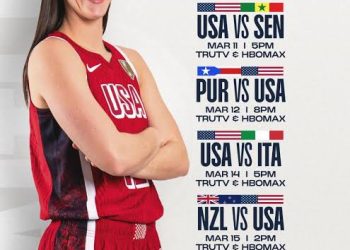
The United States women’s national basketball team has opened the qualifying stage for the FIBA Women’s World Cup in dominant fashion, winning its first two games in Puerto Rico by a combined margin of more than 100 points. Despite the comfortable victories, discussions have emerged among fans online regarding how the team’s offense is flowing—particularly when it comes to the involvement of Caitlin Clark. The Indiana Fever star generated plenty of excitement in her national team debut, but her second appearance sparked debate among viewers who felt the offensive rhythm looked slightly different.
Clark made an immediate statement in her first outing against the Senegal women’s national basketball team, delivering a standout performance with 17 points and 12 assists in a dominant win for Team USA. However, the following game against the Puerto Rico women’s national basketball team saw a more modest stat line. In that matchup, the star guard scored eight points while shooting 2-of-6 from the field during the team’s 91–48 victory. While the result was never in doubt, the change in Clark’s involvement caught the attention of many fans watching the game.
A number of viewers on social media pointed to moments involving Angel Reese as a possible explanation for Clark’s quieter performance. Clips circulating online appeared to show Reese handling the ball in transition while Clark waited for a pass that never came, leading some fans to speculate that the offense was not always running through the All-Star guard. Others suggested that Clark’s style of play—often focused on quick ball movement and creating scoring chances for teammates—was not always being mirrored by the rest of the lineup.
At the same time, there may be more practical basketball reasons behind these moments. During her time with the Chicago Sky, Reese occasionally handled the ball in a “point forward” role when injuries affected the team’s backcourt depth. Because of that experience, Team USA’s coaching staff may simply be experimenting with different offensive setups. Running plays that place Clark off the ball could also allow the sharpshooting guard to use her deep shooting range more effectively rather than constantly initiating the offense.
Ultimately, there is little evidence of any real conflict within the squad. Team USA remains the most talented team in its qualifying group and has continued to dominate opponents with ease. Early tournaments often provide opportunities for coaches to test lineups, explore new roles, and build chemistry among players. As the competition continues, both Clark and Reese are expected to remain key contributors while the team fine-tunes its strategy ahead of the upcoming world championship.