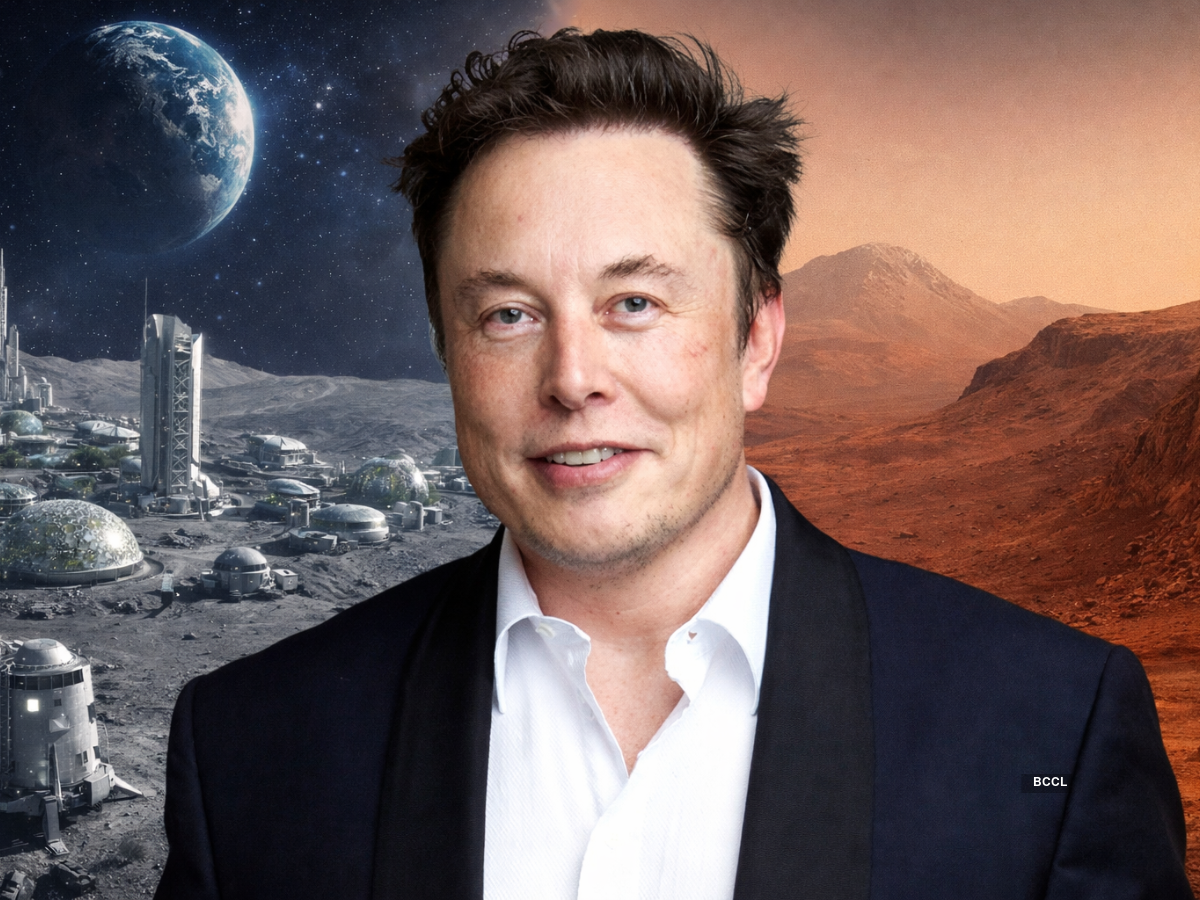
In a move that could redefine humanity’s future beyond Earth, Elon Musk today revealed an ambitious blueprint for what he calls “Lunar City” — a fully self-sustaining metropolis on the Moon targeted for completion by 2035. The announcement comes alongside news of a historic merger between SpaceX and artificial intelligence firm xAI, forming a combined entity reportedly valued at $1.25 trillion.
Speaking before a global audience during a live-streamed event, Musk described Lunar City as “the next evolutionary step for civilization,” outlining plans for a permanent settlement capable of housing over 100,000 residents within its first decade of operation.
A City Beneath the Surface
According to preliminary designs, Lunar City will be constructed primarily beneath the Moon’s surface to shield inhabitants from radiation, micrometeorites, and extreme temperature fluctuations. The settlement will feature interconnected domes and subterranean habitats powered by solar arrays positioned along the Moon’s southern polar region, where near-constant sunlight offers optimal energy generation.
The city’s infrastructure will include:
- Closed-loop life support systems for air and water recycling
- Hydroponic and vertical farming complexes
- Underground transit tunnels powered by electric autonomous vehicles
- Research and manufacturing hubs utilizing lunar regolith for 3D printing construction materials
Musk emphasized that the goal is not merely survival, but independence. “Lunar City won’t rely on constant resupply from Earth,” he said. “It must stand on its own — economically and technologically.”
SpaceX-xAI: The Engine Behind the Vision
Central to the project is the newly announced merger between SpaceX and xAI. The combined organization aims to integrate advanced artificial intelligence into every aspect of lunar development — from autonomous construction robots to self-optimizing life-support systems.
Musk stated that AI will act as the “operating system” of Lunar City, coordinating energy distribution, habitat maintenance, agricultural yields, and even emergency response systems in real time.
Industry analysts suggest the merger could accelerate innovation by unifying launch capabilities, robotics, AI research, and deep-space logistics under a single corporate structure. The reported $1.25 trillion valuation positions the merged company among the most valuable enterprises in history.
Transportation and Timeline
The transportation backbone of the initiative will rely on next-generation Starship vehicles, with upgraded cargo variants designed specifically for lunar missions. Initial robotic construction missions are slated to begin as early as 2028, focusing on landing pads, power stations, and automated excavation systems.
By 2032, Musk projects that the first human crews will arrive to oversee large-scale habitat assembly. If development proceeds on schedule, the first permanent residents could begin settling the city by 2035.
Economic Model for the Moon
Unlike previous government-led lunar efforts, Lunar City is envisioned as a commercial ecosystem. Proposed industries include:
- Helium-3 research for future fusion energy
- Rare mineral extraction
- Zero-gravity pharmaceutical manufacturing
- Space tourism and scientific research
Musk suggested that long-term success depends on creating economic value beyond Earth. “A city needs jobs, culture, and purpose,” he said. “Otherwise, it’s just a base.”
Skepticism and Global Reaction
While the announcement has sparked excitement among space enthusiasts and investors, some experts caution that the technical, financial, and regulatory hurdles remain immense. Establishing a self-sustaining ecosystem on the Moon would require breakthroughs in life-support reliability, radiation protection, and psychological adaptation to off-world living.
International space agencies have yet to formally comment, though the scale of the proposal could reshape geopolitical dynamics in space exploration.
A Multi-Planetary Future
Musk framed Lunar City as a stepping stone toward a broader multi-planetary civilization. “The Moon is practice,” he said. “Mars is the goal. But first, we prove we can build a thriving city beyond Earth.”
If realized, Lunar City would mark the most significant expansion of human presence in history — transforming the Moon from a distant symbol of exploration into humanity’s first off-world home.
For now, the world watches as one of the most ambitious space visions ever proposed moves from blueprint to countdown.